
System
Android Emu Mgr
Set up Google's Android Emulator and run virtual Android phones from one window.
- Category
- System
- Requires
- macOS 13+
- Size
- 0.5 MB
- Price
- Free
Preview
About Android Emu Mgr
Android Emu Mgr is a one-window control panel for Google's Android Emulator. It does not run Android itself. It drives Google's own command line tools, and the emulator opens in its own window. You do not need Android Studio or the Terminal.
What it does
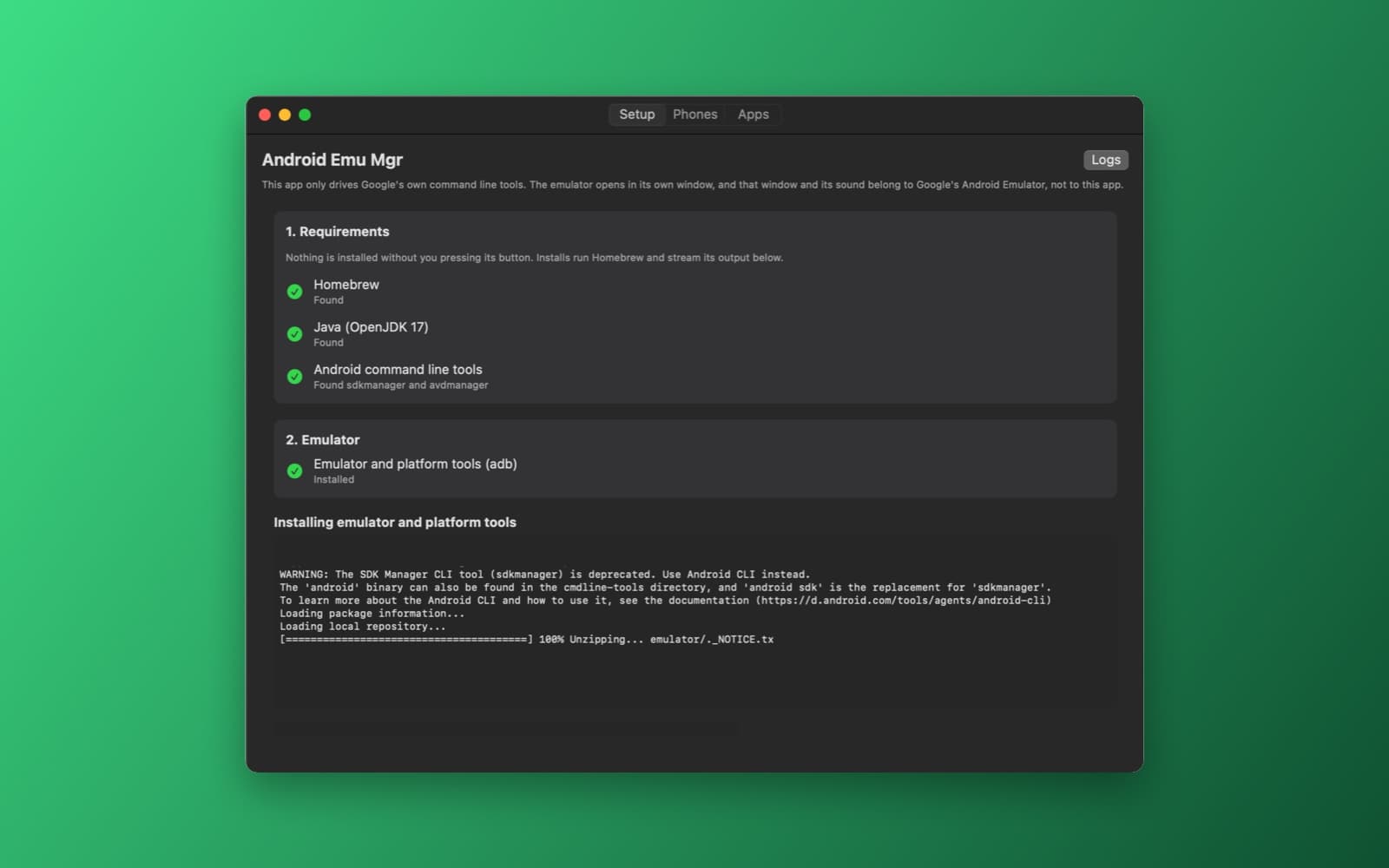
- Setup. A checklist for Homebrew, Java (OpenJDK 17) and the Android command line tools, each with a status and a button. Nothing is installed until you press its button, and every install streams its output into a log. The emulator and platform tools (adb) are installed with Google's sdkmanager into the app's own SDK folder.
- Phones. Create a virtual phone from a Pixel model and an Android version, then start, stop, wipe or delete it. Only Apple silicon (arm64) system images are offered.
- Apps. Install an .apk on the running phone, list the apps you installed with an Uninstall button for each, and take a screenshot of the phone.
- Logs. A window with the emulator's own output and the full text of any error.
How it was made
One prompt in the SiliconDevKit desktop app. The prompt asks the builder to read Google's sdkmanager, avdmanager, emulator and adb pages and the Homebrew pages before writing code. The cloud wrote the code and a Mac compiled it.
Notes
The emulator window and its sound belong to Google's Android Emulator, not to this app. The screenshot shows the Setup tab with everything installed, and the SDK folder path is hidden. We checked the Setup tab: it found Homebrew, Java and the command line tools, and installed the emulator and platform tools. We did not test the Phones and Apps tabs (creating, starting and stopping phones, installing apps, screenshots) end to end. Google's emulator needs a few gigabytes for the system image of each Android version.
Information
- Developer
- SiliconDevKit (generated by AI from a prompt)
- Category
- System
- Compatibility
- macOS 13 or later, Apple silicon, Homebrew. Apple silicon Macs only (M1 or later), not Intel
- Size
- 0.5 MB (.dmg)
- Latest version
- 1.0
- Price
- Free
- Signing
- Ad-hoc signed, not notarized
The prompt behind it
This app was generated from the prompt below. Paste it into SiliconDevKit to build your own version, then change it however you like.
Build a native Mac app called Android Emu Mgr: a one-window control panel that sets up Google's Android Emulator on an Apple silicon Mac and runs virtual Android phones, with no Android Studio and no Terminal. The app does not run Android itself. It drives Google's own command line tools, and the emulator opens in its own window. RESEARCH FIRST (use WebSearch and WebFetch before you write code) These tools change often, so do not rely on memory. Before writing code, read: (1) https://developer.android.com/tools/sdkmanager, https://developer.android.com/tools/avdmanager, https://developer.android.com/studio/run/emulator-commandline and https://developer.android.com/tools/adb for the exact commands and flags; (2) https://formulae.brew.sh/cask/android-commandlinetools and the Homebrew page for a Java runtime (a cask or formula for OpenJDK that the tools can use), and where each installs; (3) the current list of system images for Apple silicon: run the real command `sdkmanager --list` in your head from the docs and pick arm64-v8a images only (Android 14 or 15, "google_apis" and "google_apis_playstore" variants). Where a page disagrees with this prompt, follow the page and say what changed. SETUP (honest, one click, nothing installed without asking) - This app needs an Apple silicon Mac. If the Mac is Intel, say so plainly and stop. - Find the tools: sdkmanager and avdmanager (under the Android SDK folder or cmdline-tools/latest/bin), emulator and adb (platform-tools). Use the SDK folder at Application Support/Android Emulator Manager/sdk unless an ANDROID_HOME already has them. Run every tool with Process and an argument array, never a shell string, with a PATH and JAVA_HOME that you set, a 10 second timeout for quick calls and no timeout for downloads. - A checklist card with three rows, each with a status and one button: Homebrew (if missing, a "Get Homebrew" button that opens brew.sh; never install it yourself), Java (brew install the OpenJDK that the docs say sdkmanager needs), and the Android command line tools (brew install --cask android-commandlinetools, or download the official zip into the app's SDK folder and unpack it with /usr/bin/unzip into cmdline-tools/latest). Each install streams its output into a log with a progress bar and a Cancel button. Accept the SDK licenses only after showing the license text and a clear "I accept" button, then run sdkmanager --licenses answering for the user. - "Install the emulator": run sdkmanager to install emulator and platform-tools, with the download size shown if the docs allow it, and the output streamed. PHONES - "New phone": choose a Pixel model name from avdmanager list device, an Android version (the system images installed or available), and Google Play or not (say that Google Play images are the only ones that include the Play Store). If the system image is not installed, offer to install it (about 1.5 GB) before creating. Create it with avdmanager create avd, with the name the user chooses, and show the real error text if it fails. - A list of phones (avdmanager list avd) with Start, Stop, Wipe data and Delete (with confirmation). Start runs emulator -avd <name> as a child process the app watches; show Starting, Booting (until adb shell getprop sys.boot_completed returns 1) and Running. Offer options: cold boot, no snapshot, a window scale, and a GPU mode of auto. Stop sends the emulator's kill command through adb emu kill and falls back to terminating the process after 10 seconds. - Install apps: a drop zone and a button for .apk files that runs adb install -r on the running phone, shows the output, and lists the installed packages (adb shell pm list packages -3) with an Uninstall button each. A "Take screenshot" button using adb exec-out screencap -p with a save panel. - Logs: a window with the emulator's own output and a Show Details box for any error. QUALITY - macOS 13, Swift 5 language mode, SwiftUI with ObservableObject and @Published. Only Apple frameworks, no packages, no Xcode project or asset catalog. Modular: AndroidTools (finds and runs the tools, parses their output), SetupController, PhoneStore, EmulatorProcess (start, watch, stop), ApkInstaller and the views. - Read process output with pipe readability handlers and never block the main thread. Parse avdmanager and sdkmanager text output carefully, and show the raw text when parsing fails. - The code is compiled later on the user's Mac, not here, so check every initializer, argument label and optional. No force-unwraps. - Do not fake anything: no sample phones, no pretend progress. If something cannot work, show that state in the app. The emulator window and its sound are Google's, and the app must say that. - In your reply, say in a few sentences what you built, what the lookups changed, and what you could not test (none of the tools were run, so the install steps, the boot detection and adb installs are untested).
What it cost
Every AI run that made this demo, one per line. Model: Claude Sonnet 5.5. Tokens are shown as (in / out). “In” counts everything the model read, including text it had already seen in the session at a reduced price.
| Initial prompt(609k in / 54k out) | 100 credits | |
| = | Total(609k in / 54k out) | 100 credits |
Credits are what a build uses on your plan. This counts AI usage only: hosting and the Mac that compiled it are not included.
Version tree
Every change to this app is a new version. Use any build as a template to start your own copy from it; forks that their makers shared appear as branches.
Version 1.0Oct 10, 2026
Build a native Mac app called Android Emu Mgr: a one-window control panel that sets up Google's Android Emulator on an Apple silicon Mac and runs virtual Android phones, with no Android Studio and no Terminal. The app does not run Android itself. It drives Google's own command line tools, and the emulator opens in its own window. RESEARCH FIRST (use WebSearch and WebFetch before you write code) These tools change often, so do not rely on memory. Before writing code, read: (1) https://developer.android.com/tools/sdkmanager, https://developer.android.com/tools/avdmanager, https://developer.android.com/studio/run/emulator-commandline and https://developer.android.com/tools/adb for the exact commands and flags; (2) https://formulae.brew.sh/cask/android-commandlinetools and the Homebrew page for a Java runtime (a cask or formula for OpenJDK that the tools can use), and where each installs; (3) the current list of system images for Apple silicon: run the real command `sdkmanager --list` in your head from the docs and pick arm64-v8a images only (Android 14 or 15, "google_apis" and "google_apis_playstore" variants). Where a page disagrees with this prompt, follow the page and say what changed. SETUP (honest, one click, nothing installed without asking) - This app needs an Apple silicon Mac. If the Mac is Intel, say so plainly and stop. - Find the tools: sdkmanager and avdmanager (under the Android SDK folder or cmdline-tools/latest/bin), emulator and adb (platform-tools). Use the SDK folder at Application Support/Android Emulator Manager/sdk unless an ANDROID_HOME already has them. Run every tool with Process and an argument array, never a shell string, with a PATH and JAVA_HOME that you set, a 10 second timeout for quick calls and no timeout for downloads. - A checklist card with three rows, each with a status and one button: Homebrew (if missing, a "Get Homebrew" button that opens brew.sh; never install it yourself), Java (brew install the OpenJDK that the docs say sdkmanager needs), and the Android command line tools (brew install --cask android-commandlinetools, or download the official zip into the app's SDK folder and unpack it with /usr/bin/unzip into cmdline-tools/latest). Each install streams its output into a log with a progress bar and a Cancel button. Accept the SDK licenses only after showing the license text and a clear "I accept" button, then run sdkmanager --licenses answering for the user. - "Install the emulator": run sdkmanager to install emulator and platform-tools, with the download size shown if the docs allow it, and the output streamed. PHONES - "New phone": choose a Pixel model name from avdmanager list device, an Android version (the system images installed or available), and Google Play or not (say that Google Play images are the only ones that include the Play Store). If the system image is not installed, offer to install it (about 1.5 GB) before creating. Create it with avdmanager create avd, with the name the user chooses, and show the real error text if it fails. - A list of phones (avdmanager list avd) with Start, Stop, Wipe data and Delete (with confirmation). Start runs emulator -avd <name> as a child process the app watches; show Starting, Booting (until adb shell getprop sys.boot_completed returns 1) and Running. Offer options: cold boot, no snapshot, a window scale, and a GPU mode of auto. Stop sends the emulator's kill command through adb emu kill and falls back to terminating the process after 10 seconds. - Install apps: a drop zone and a button for .apk files that runs adb install -r on the running phone, shows the output, and lists the installed packages (adb shell pm list packages -3) with an Uninstall button each. A "Take screenshot" button using adb exec-out screencap -p with a save panel. - Logs: a window with the emulator's own output and a Show Details box for any error. QUALITY - macOS 13, Swift 5 language mode, SwiftUI with ObservableObject and @Published. Only Apple frameworks, no packages, no Xcode project or asset catalog. Modular: AndroidTools (finds and runs the tools, parses their output), SetupController, PhoneStore, EmulatorProcess (start, watch, stop), ApkInstaller and the views. - Read process output with pipe readability handlers and never block the main thread. Parse avdmanager and sdkmanager text output carefully, and show the raw text when parsing fails. - The code is compiled later on the user's Mac, not here, so check every initializer, argument label and optional. No force-unwraps. - Do not fake anything: no sample phones, no pretend progress. If something cannot work, show that state in the app. The emulator window and its sound are Google's, and the app must say that. - In your reply, say in a few sentences what you built, what the lookups changed, and what you could not test (none of the tools were run, so the install steps, the boot detection and adb installs are untested).
Sets up Google's Android Emulator on an Apple silicon Mac and runs virtual Android phones from one window.
Opening it for the first time
- Open the .dmg and drag Android Emu Mgr onto the Applications folder.
- Open it from Applications. macOS may say it can’t check the app for malicious software. Click Done.
- Open System Settings → Privacy & Security and click Open Anyway. This is needed once. Why this happens. To share an app without the warning, see how to notarize it.
You might also like
 Get
GetPlayTube
Paste a video link and watch it in a clean player, with no ads.
 Get
GetAdMute
Listens to your Mac's audio and mutes the ads, then brings the sound back.
 Get
GetToob-Downer
Paste a video link and save the video to your Mac, with a queue to keep track.
 Get
GetAgent Swarm
Send one task to Claude, Gemini and Hermes at once.